
Industry leaders at an AIMA panel discussion emphasised the need for businesses to quickly adapt to changing market conditions and invest in technologies like artificial intelligence to build resilience and achieve long-term growth. They highlighted the current era of uncertainty driven by geopolitical tensions, supply chain disruptions, and rapid regulatory changes, stressing that tactical responses are as crucial as long-term strategy.

A joint report by Dell Technologies and Zinnov reveals that despite high ambition, nearly 70% of India's Global Capability Centres (GCCs) are stuck at the pilot stage for AI adoption. Foundational gaps in data, infrastructure, and governance are identified as key bottlenecks preventing the scaling of AI initiatives into enterprise-wide production. The report highlights the need for significant reskilling of the workforce and robust foundations for industrialising AI responsibly.

India is developing a 'Gross Domestic Knowledge Product' (GDKP) to identify and define its knowledge assets, a move aimed at safeguarding them amidst global efforts to monetise and 'weaponise' knowledge, according to NITI Aayog member R Balasubramaniam.

The larger question raised by the associations is simple: If ISRO is no longer to manufacture launch vehicles, what will happen to the institution's accumulated capabilities and the people who built them?

Karnataka Chief Minister D K Shivakumar lauded KEONICS' initiative to provide AI-based KEO computers to rural children, marking the institution's golden jubilee. The KEO computers, developed in Karnataka, aim to bridge the digital divide. Shivakumar also highlighted government efforts to promote IT beyond Bengaluru, enhance industry-oriented skills, and digitise property records, emphasising the state's commitment to technology and skill development.

India is deeply concerned by the growing consolidation of Pakistan-backed jihadi and radical Islamist groups in Bangladesh, particularly in the strategically vital Chittagong Hill Tracts, which experts warn is transforming the country into a new safe haven for these networks and posing a direct threat to India's security.

'Indian IT firms must hire and train more Americans while reducing dependence on sending employees from India to the US.'

GIS intelligence solutions provider Mirai Aerospace Systems and Software Solutions has signed an MoU with US-based GreenValley International Inc to strengthen India's geospatial and LiDAR remote sensing manufacturing base. The collaboration focuses on local assembly, manufacturing, technical support, and the development of AI-driven LiDAR applications, aiming to meet India's growing demand across various sectors.

'While the population remains relatively young, its age structure is beginning to shift, setting the stage for a much older population later this century.'
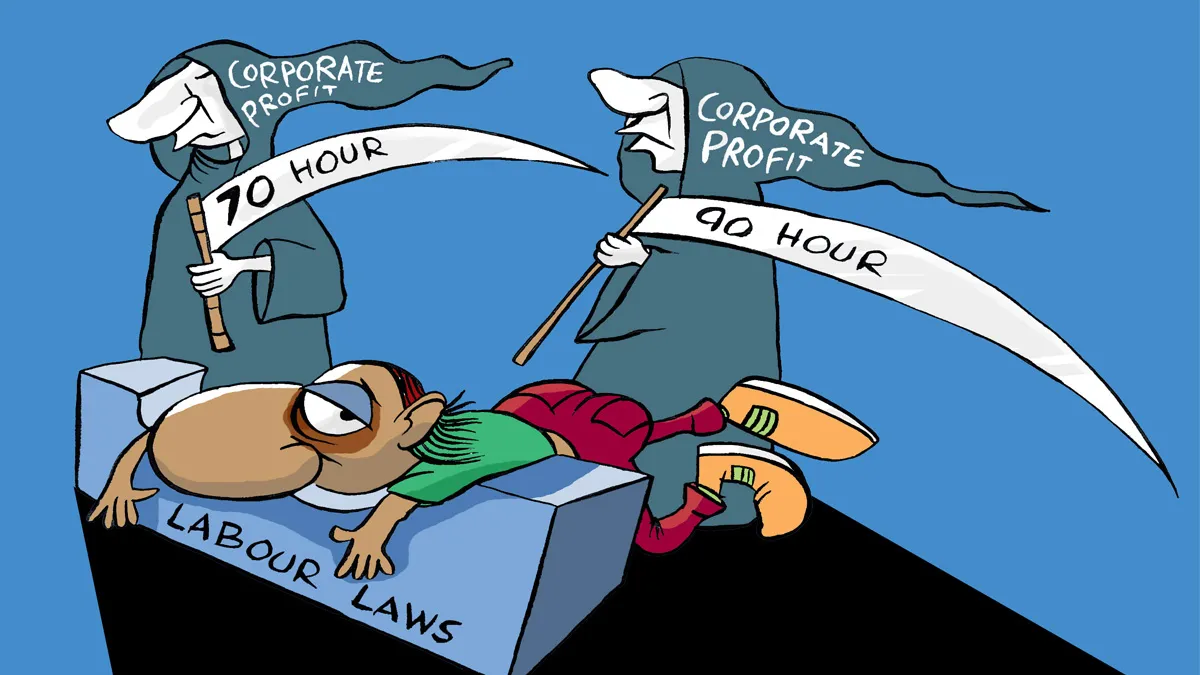
The Indian government is pressing all states and Union Territories (UTs) to publish their rules under the four new labour Codes by October 31, aiming to fully operationalise the new labour law framework. This move is crucial as labour falls under the concurrent list, requiring state-level rule-making for effective implementation.

A LinkedIn post by Pooja Sahu, detailing her husband Sourabh's sudden layoff from Oracle after 12 years of dedicated service, including working through holidays and even from a hospital, has gone viral, capturing the emotional toll of the tech giant's latest job cuts.

An Indian-origin engineer couple, Anuradha and Vikas Sinha, have donated $20 million to the University of North Texas (UNT) to establish the Anuradha and Vikas Sinha College of Artificial Intelligence and Advanced Analytics. This significant gift aims to create new opportunities for students and faculty, focusing on building and deploying intelligent systems and understanding their operation within human contexts. The donation underscores the couple's belief in education and immigrant contributions to the American dream, supporting leadership, scholarships, professorships, research, and entrepreneurship.

Their message is blunt: Public scientific wealth should not be transferred at what they describe as 'throwaway prices'.capability, recruitment, promotional avenues and the voice of its employees.

Comparing the two states is comparing an apple to an orange. I ate apples for years. Then I felt I needed some citrus, and I moved to oranges. That doesn't make the apple a lesser fruit, reflects Binu Alex.

Nagaland Governor Nand Kishore Yadav has advocated for increased use of technology, especially drones and geospatial systems, to enhance governance and create employment opportunities for the state's youth. During his visit to the Nagaland GIS and Remote Sensing Centre and Drone Centre of Excellence, he highlighted the broad applications of drone technology and the importance of skill development. The centre is actively training youth in various drone-related courses, aiming to meet the demand for drone pilots in the Northeast.

A rocket designed and developed by ISRO is being transferred to industry for production.
Nine ISRO associations want to know whether this is simply an effort to expand India's industrial capacity or part of a larger policy under which ISRO itself will eventually withdraw from rocket manufacturing.

Southern chief ministers fear population stabilisation could reduce their parliamentary representation and tax devolution benefits.

A report by policy think tank The Dialogue reveals that India's artificial intelligence (AI) ecosystem is primarily constrained by a shortage of skilled talent and a lack of data standardisation, rather than market concentration. The study, which surveyed 308 stakeholders, found that talent availability and data usability are major concerns, with a significant reliance on open-source AI models.

IICT and Netflix are offering scholarships to 100 students and working professionals, with up to 80 per cent financial support for courses in animation, VFX, gaming and creative technologies.

Prime Minister Narendra Modi cautioned against the 'weaponisation' of technology and critical minerals at the BRICS summit, advocating for cooperation to foster shared prosperity. Concurrently, Chinese President Xi Jinping announced plans for an open-source AI ecosystem for BRICS nations, positioning Beijing as a key technology partner amid global AI competition.
Minister of State for Telecom Chandra Sekhar Pemmasani urged BRICS nations to collaborate on building institutional capacity and advocating for fair standards in international telecom and ICT bodies. He highlighted India's willingness to share its modular, open-source digital public infrastructure frameworks like Aadhaar and DigiLocker, emphasising their role in sustainable development and economic growth across the Global South.

For India, the goal is not simply to host another grand diplomatic gathering. It is to prove that a diverse coalition of emerging powers can still deliver.
Goa has successfully completed its first pilot drone-skilling workshop for 12 women and plans to train 100 women annually under the Goa Drone Didi Training Scheme. This initiative aims to promote drone technology, rural livelihoods, and women-led entrepreneurship, aligning with the Centre's Namo Drone Didi programme.
Prof Ajit Kumar Chaturvedi, Vice-Chancellor of Banaras Hindu University, highlighted Artificial Intelligence's transformative potential in healthcare, emphasising its role in augmenting doctors' capabilities and enhancing efficiency. Speaking at PGIMER's Foundation Day, he stressed the need for India to develop AI solutions tailored to its unique healthcare realities, moving beyond being a mere consumer of Western-trained systems. PGIMER Director Vivek Lal also detailed the institute's expansion and commitment to affordable healthcare.

How well is your country's healthcare system staffed? We compare the density of essential healthcare professionals across countries, based on figures from World Population Review.

Prime Minister Narendra Modi has outlined a comprehensive plan to empower India's youth, including training one crore youngsters in artificial intelligence skills and providing free online coaching for competitive examinations, aiming to position them at the forefront of the nation's journey to become a developed nation by 2047.

In the next 36 months nearly 25 to 40 per cent of jobs will be under threat from AI and job losses are inevitable.

Nasscom has warned that India's technology workforce risks becoming merely AI-reliant rather than truly AI-native if deep engineering expertise is not preserved. The industry body highlights that while many professionals adopt AI, only a fraction are AI-native, necessitating a shift in academic and industry approaches to foster foundational skills and independent problem-solving.

Andhra Pradesh has launched India's first quantum reference facility, aiming to build a sovereign hardware ecosystem and boost indigenous manufacturing of advanced computing systems.

Global tech major Salesforce has committed to equipping one million learners across India with AI-focused skills by 2030, leveraging government partnerships, virtual internships, academic centres, and its partner network.

Tata Consultancy Services (TCS) and Google Cloud have inaugurated a new Gemini Experience Center (GEC) in Mexico City. This facility, the second in Latin America and ninth globally for TCS, is equipped with over 3,000 AI agents and aims to drive industry-specific AI solutions across various sectors. It will help organisations bridge the gap between AI experimentation and implementation, enhancing innovation and data-driven decision-making in the region.
Andhra Pradesh and Punjab National Bank (PNB) have signed an MoU to establish the PNB Quantum Finance Hub at Amaravati Quantum Valley. This initiative aims to foster innovation and adopt next-generation technologies like AI and Quantum Computing in the banking sector, focusing on cybersecurity, fraud detection, and customer experience.

'If a student can get a good teacher, quality content and mock tests at no cost, it becomes very hard for a mid-tier coaching centre to keep charging for the same lecture.'

'The main problem the country faces is not low GDP growth, but low employment growth.'
Maharashtra Chief Minister Devendra Fadnavis announced the state's ambition to become India's leader in quantum technology. The state plans to build a robust ecosystem, align with the National Quantum Mission, and train over 5,000 professionals, recognising AI, semiconductors, and quantum tech as key pillars for future growth and global competitiveness.
An independent study reveals that while Geographical Indication (GI) registration has boosted the identity of Kerala's traditional handloom products, it has not uniformly translated into economic benefits across weaving clusters. Challenges include an ageing artisan population, competition from powerloom products, rising raw material costs, and inadequate marketing.

Indian IT service providers face heightened competition from AI-native firms in the next three years, potentially eroding their revenue base unless they remain competitive and protect recurring businesses, according to a report by S&P Global Ratings.
NIT Rourkela has announced the launch of four new academic programmes for the 2026-27 session, focusing on emerging technologies such as semiconductors, artificial intelligence, and quantum technologies.

'For every 10,000 applicants, even an additional Rs 300 to Rs 700 per candidate for testing, assessment administration and re-screening can mean Rs 30 lakh to Rs 70 lakh extra at the hiring-stage cost before training begins.'

Former UGC Chairman M Jagadesh Kumar emphasises the need to focus on skills like judgement, creativity, and ethical reasoning in light of rapid automation in the workplace.
